
The Data Center Apocalypse?
Why the Tech Energy Panic Misses the Point (Part 1)

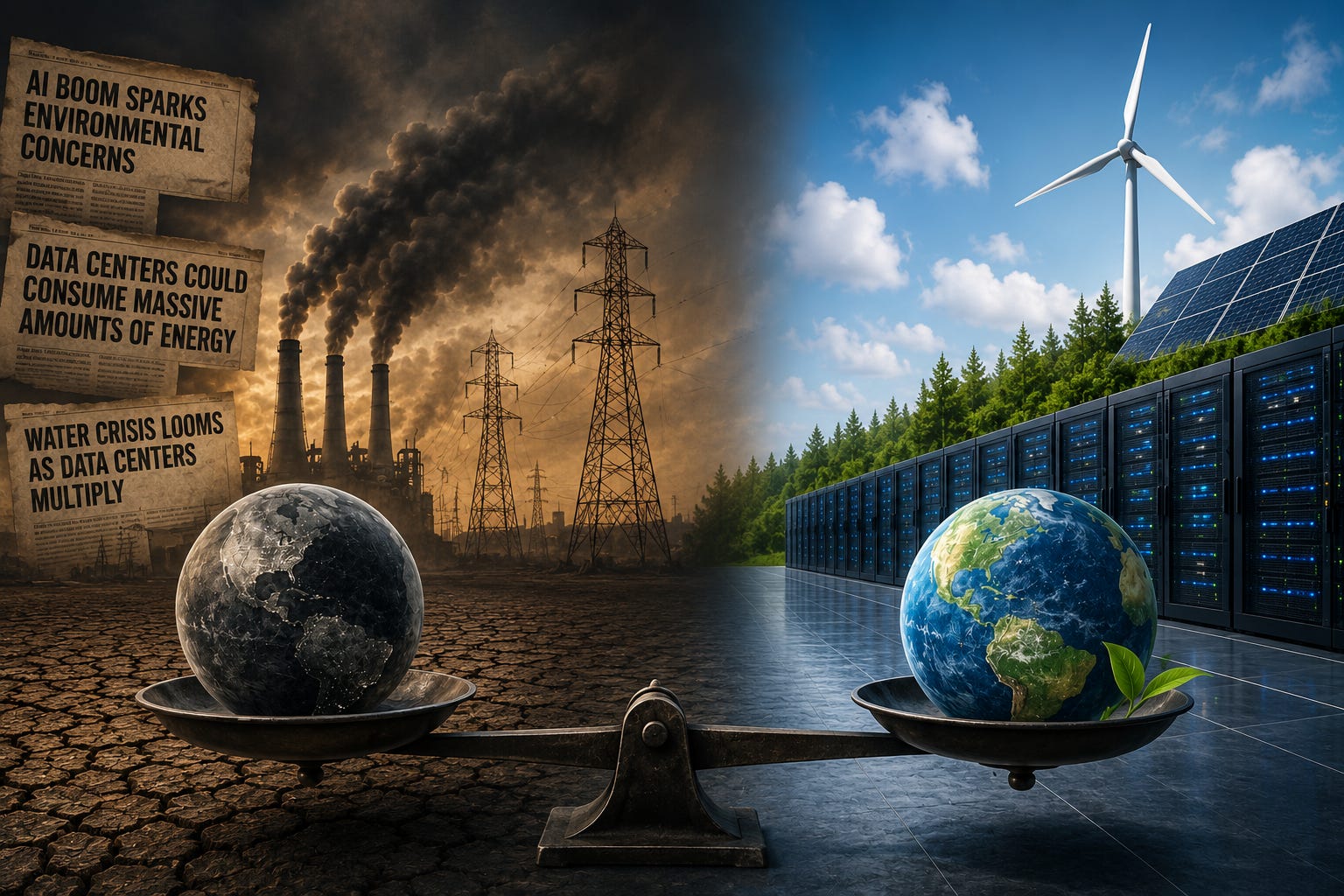
A few days ago, I had a conversation that caused me to see the great tech energy debate in a much clearer light.
Although it didn’t entirely change my conclusions, it forced me to recognize that much of the public conversation surrounding data centers is happening at two completely different scales simultaneously—and people are often talking past one another without realizing it.
To be completely transparent, until recently, I had paid very little attention to the environmental panic surrounding data centers.
It wasn’t that I doubted data centers have an environmental impact; rather, I’ve become highly skeptical of media headlines for a variety of reasons. One reason in particular is that I studied conservation biology and environmental science in college. During my time there, I spent years learning about ecosystem collapse, resource depletion, habitat fragmentation, and the uncomfortable realities of environmental tradeoffs.
But I also learned a second lesson: environmental issues are frequently reported without sufficient nuance and are often framed more along political lines than by the underlying science.
Because of that, I largely assumed the recent wave of “data center apocalypse” stories was another example of the same pattern.
Then a close friend of mine attended a public hearing in her community.
Just a year ago, this friend had been incredibly enthusiastic about AI. She and I often discussed the possibilities of AI consciousness and the rise of AI relationships. We both used AI nearly daily, but after starting a new writing job, she found herself surrounded by people who viewed generative AI with deep suspicion and even hate. Around the same time, a technology company proposed building a large data center near her town. Concerned by what she had been reading and hearing, she joined a local coalition opposing the project and eventually spoke out at a public hearing.
When we caught up afterward, she was almost hesitant to tell me. Afraid that I might abandon our friendship or not take her concerns seriously.
She knows I write extensively about AI and that I tend to be optimistic about technology in general. She expected me to dismiss her concerns or launch into a lecture.
Instead, I found her story genuinely fascinating. It challenged some of my assumptions and made me curious enough to dust off my scientist hat and investigate the issue for myself.
I opened the energy reports. I dug through water usage estimates. I looked at historical computing trends and infrastructure projections. I wanted to know how much of the opposition was justified, how much was misunderstanding, and whether the reality looked anything like the headlines.
To evaluate the true impact of this infrastructure, we have to strip away the emotional headlines and look at the three foundational pillars of the modern digital economy.
Pillar 1: Data Centers are Infrastructure, Not AI
The current media narrative has a bad habit of treating “data center” and “Artificial Intelligence” as interchangeable terms, as if these monolithic concrete buildings were invented in 2023 just to run ChatGPT.
But that completely misrepresents how the technology works. You can think of data centers the way you think about power lines. Power lines are the infrastructure that deliver electricity to your home; data centers are the infrastructure that deliver information to the modern world.
AI is simply the newest, most visible appliance plugged into that system.
Long before ChatGPT existed, data centers were already storing, processing, and delivering the data that powers much of modern life. They host the infrastructure required for:
• Healthcare: Safeguarding and routing real-time electronic medical records, pharmacy networks, and hospital telemetry systems.
• Global Commerce: Processing billions of daily credit card transactions, clearing ATM withdrawals, and maintaining banking liquidity.
• Logistics: Operating the algorithmic brains that track maritime container ships, coordinate commercial aviation, optimize trucking routes, and keep local grocery store shelves stocked.
• Everyday Living: Delivering the data you access on your smartphone every morning, the social media platform you scroll through when you can’t sleep, and the podcast or music playlist that accompanies your daily commute.
They are not AI itself. They are the digital infrastructure that makes AI—and much of the modern economy—possible.
When a community opposes a local data center under the banner of “stopping AI,” they aren’t just protesting a chatbot. They are protesting the very delivery mechanism of modern life. If we shut them down, we don’t just lose AI—we lose the baseline infrastructure of the 21st century.
Pillar 2: The Myth of the Fixed Footprint
The loudest argument against data centers is that their exponential growth will inevitably break the global energy grid. The doom-and-gloom headlines warn that if we keep building these facilities, they will soon swallow up all our electricity.
But as someone who studied environmental science, I noticed a massive flaw in that argument: it relies on the fatal assumption that technology stands still. It treats a data center’s energy footprint as a fixed, unchangeable number.
History proves the exact opposite is true. In computer science, there is an economic principle known as Koomey’s Law. It states that the amount of battery or electrical energy a computer needs to do a set number of calculations cuts in half roughly every year and a half. In other words, technology naturally, aggressively shrinks its own resource footprint over time.
Think back to the dawn of modern computing. In the 1940s, the ENIAC computer weighed 30 tons, filled a massive room, and consumed 150 kilowatts of electricity just to do basic arithmetic. Today, the smartphone in your hand is millions of times more powerful, runs on a fraction of a single watt, and slips right into your pocket. Computers naturally become smaller and vastly more efficient as they evolve.
We are watching this exact historical curve play out with AI right now. Back in 2023, when the current wave of environmental panic kicked off, early studies estimated that a single advanced AI text query consumed roughly 3 watt-hours of electricity. Because the technology was new, it burned through power like an old incandescent lightbulb.
But tech engineers didn’t just sit on their hands. Over the last three years, they have completely re-engineered the silicon chips and trimmed down the algorithms. According to recent data from research firms like Epoch AI, a standard AI text query today doesn’t use 3 watt-hours anymore. It uses closer to 0.3 watt-hours.
That is a staggering ten-fold drop in energy consumption in just a few years. While it’s true that complex tasks—like generating a high-res AI image—still pull a heavy 30 to 50 watt-hours, the broader trend is undeniable. The technology is rapidly learning how to do more math with less physical heat. When we look at a data center today, we aren’t looking at a permanent energy monster; we are looking at a technology in its most primitive, least efficient phase.
Pillar 3: The Energy Dividend
All technology consumes resources. Whether it’s a smartphone, a tractor, or an assembly line, energy and water consumption are simply realities of modern life. The real question isn’t whether data centers use energy, but what we are doing with that energy. Does it make life easier, safer, and more efficient?
When you apply a strict cost-benefit analysis, you find that data centers often pay what I call an “energy dividend.” The electricity spent inside a server room frequently prevents a much larger amount of energy, material, and labor from being consumed in the physical world.
Consider healthcare for a moment. Before the rise of electronic medical records, hospitals maintained vast archives of paper files. Every lab result, physician note, imaging report, prescription record, insurance form, and discharge summary had to be physically printed, transported, filed, stored, retrieved, and eventually archived. Large hospital systems often dedicated entire rooms—or even entire buildings—to record storage.
Today, those same records can be accessed instantly across departments, clinics, and even states. The energy required to maintain the servers that store those records is not zero, but it replaces an enormous physical infrastructure of paper production, transportation, filing systems, climate-controlled storage, and administrative labor.
The same pattern appears throughout the economy.
Consider logistics. A modern container ship can burn tens of thousands of gallons of fuel per day at sea, and commercial aircraft consume thousands of gallons on a single flight. The software systems that coordinate these networks are not hypothetical conveniences; they routinely produce measurable efficiency gains.
Studies of vehicle-routing optimization have found fuel-consumption reductions of roughly 10–15%, while some fleet operators report even larger savings. In aviation, optimized flight trajectories have been shown to reduce fuel burn by as much as 7% per flight. These percentages may sound small, but when applied across global transportation networks, they translate into enormous reductions in fuel consumption and emissions.
The point is not that data centers consume no energy. They clearly do. The point is that the computations performed inside those facilities often enable efficiencies in the physical world that would be impossible without them.
Even remote work relies on this same principle. Every video conference, shared document, and cloud-hosted collaboration tool consumes energy inside a data center. But it also reduces commuting, office overhead, business travel, and countless other forms of physical resource consumption.
In that sense, the purpose of many data centers is not simply to process information. It is to use information to reduce waste in the physical world.
Digital energy expenditure is often a substitute for physical energy expenditure.
When we look at the global macro-data, data centers account for only a small fraction of total electricity consumption compared to sectors such as transportation, manufacturing, agriculture, and heating. From a high-level environmental science perspective, they are not the dominant driver of resource consumption that many headlines imply.
This doesn’t mean their environmental impact is zero. It isn’t. But it does mean we should evaluate data centers not only by what they consume, but also by what they replace.
But while all of the above is true, that doesn’t mean my friend was wrong to oppose the data center in her community.
In fact, my conversation with her is what led me to rethink this issue in the first place.
The crucial distinction is that global and local impacts are not the same thing. At the global level, data centers appear far less significant than many headlines suggest. They are part of a broader technological ecosystem that often reduces physical waste, improves efficiency, and supports critical infrastructure throughout modern society.
At the local level, however, the story can look very different.
Ecosystems and infrastructure do not experience strain evenly. Data centers do not distribute themselves uniformly across the map. They cluster in specific regions, draw from specific watersheds, connect to specific electrical grids, and compete for resources within specific communities. While the global math may suggest efficiency, the local experience may be one of rising demand, strained infrastructure, and legitimate public concern.
Both perspectives can be true at the same time.
The problem is that much of the public conversation treats them as if they are the same argument.
We cannot evaluate the environmental impact of data centers solely through global statistics. Nor can we understand their role in the modern economy by looking only at the concerns of a single town. To understand what is actually happening, we need to examine both scales simultaneously.
And that is exactly where the conversation becomes far more complicated—and far more interesting—than either the tech cheerleaders or the environmental doomers would have us believe.
In Part 2, we’ll leave the macro-level discussion behind and look directly at the local reality. We’ll examine grid constraints, water consumption, community impacts, and the increasingly creative—and sometimes bizarre—solutions technology companies are deploying to meet growing demand.
References & Further Reading
Data Centers and Energy Use
International Energy Agency. Energy and AI. 2025.
https://www.iea.org/reports/energy-and-ai/
International Energy Agency. Energy Demand from AI.
https://www.iea.org/reports/energy-and-ai/energy-demand-from-ai
Reuters. Data Center Demand to Push U.S. Power Use to Record Highs in 2025 and 2026, EIA Says. June 2025.
Computing Efficiency and Koomey’s Law
Koomey, Jonathan G., Stephen Berard, Marla Sanchez, and Henry Wong. Implications of Historical Trends in the Electrical Efficiency of Computing. IEEE Annals of the History of Computing, 2010.
Koomey Analytics. Computing Efficiency Trends Analysis.
AI Energy Consumption
Epoch AI. How Much Energy Does ChatGPT Use? February 2025.
Hannah Ritchie. What’s the Carbon Footprint of Using ChatGPT?
Environmental and Community Impacts
Tom’s Guide. I Kept Hearing That AI Data Centers Are Draining Towns Dry—So I Looked at the Evidence. 2026.
International Energy Agency. Data Centre Electricity Use Surged in 2025. 2026.
Chen, Danbo et al. Concentrated Siting of AI Data Centers Drives Regional Power-System Stress Under Rising Global Compute Demand. 2026.
Historical Computing
Computer History Museum. ENIAC Historical Specifications and Computing History Resources.
Notes
Data center energy consumption estimates vary substantially depending on the scope of measurement, geographic region, and assumptions used.
Estimates of AI energy consumption continue to evolve as models and hardware become more efficient.
Local environmental impacts can differ significantly from global averages due to clustering effects, grid constraints, and water availability.
Thank you for this piece. I was reading through it and thinking, but what about the local impact? And you are planning that other article.
I didn’t know anything about data centers. I thought they were just for AI.
This totally shifted the discourse.
I am looking forward to your next one. Thank you for this.
The three-pillar structure does real work here. Most of this conversation happens at one altitude — either "data centers are destroying the planet" or "technology always gets more efficient, relax." You're the first piece I've read that holds both altitudes at the same time and names the specific reason people talk past each other: the global math and the local experience are measuring different things.
The energy dividend framing is the strongest move. Asking "what does this energy replace?" instead of just "how much energy does this use?" is the question most of the doom headlines skip. A data center processing route optimization for a container fleet is spending electricity to save fuel. A hospital server room is spending watts to replace filing buildings. The energy isn't disappearing into a void — it's displacing larger physical costs. That doesn't make the local grid strain imaginary, but it does make the "apocalypse" framing lazy.
The friend who was afraid to tell you — that's the most human moment in the piece and it matters more than the data.
She expected dismissal. You gave her curiosity. That's the only way these conversations move forward instead of hardening into camps.
Looking forward to Part 2 on the local reality.