
Mapping the Mechanism of Understanding Part I
From toddler logic to ant confusion. How internal models shape meaning across humans, animals, and AI.


What Does It Mean to Understand?
This might sound like a simple question, but understanding is an abstract concept with many dimensions.
Consider the difference between these two statements:
2 + 2 = 4
They’re having two sets of twins.
In mathematics, 2+2 will always equal 4. The relationship is fixed, deterministic, rule-based. A system could endlessly repeat “2+2=4” without truly comprehending what 2 means, what addition represents, or what 4 signifies. You can apply this rule mechanically: if someone asks “what is 2+2?” you output “4.” No internal model required.
But now consider what it actually means for a couple to have two sets of twins. Four babies at once.
To understand this, you need to build a complex internal model that generalizes across multiple domains:
Financial implications: Four times the diapers, formula, clothes, car seats, cribs.
Physical demands: Four times the feedings in the night. Four babies crying at different times or all at once.
Logistical constraints: You can’t fit four car seats in most vehicles, so they’ll need a bigger car.
Social and emotional impact: The isolation of being too overwhelmed to see friends. The strain on the relationship when both parents are running on empty.
Long-term trajectory: Four kids hitting every milestone simultaneously. Four starting school the same year. Four teenagers at once.
None of this is contained in “2+2=4.” You cannot derive the meaning of “two sets of twins” from mathematical operations alone. Understanding this scenario requires:
Generalization: Drawing on knowledge about infant care, parenting, human physiology, social dynamics, and economics
Internal modeling: Building a mental simulation of what this life would actually be like
Contextual adaptation: Recognizing how this would be different for a wealthy couple vs. a struggling family, for parents with support vs. those without
Meaningful inference: Predicting outcomes and challenges that aren’t explicitly stated
Understanding is the ability to generalize, adapt, and respond meaningfully across time and context.
It’s not about memorizing facts or applying rules. It’s about building internal models rich enough to navigate novel situations, predict outcomes, and respond appropriately even when you’ve never encountered that exact scenario before. ( Something that AI systems already do!)
What Understanding Looks Like: A Real-World Example
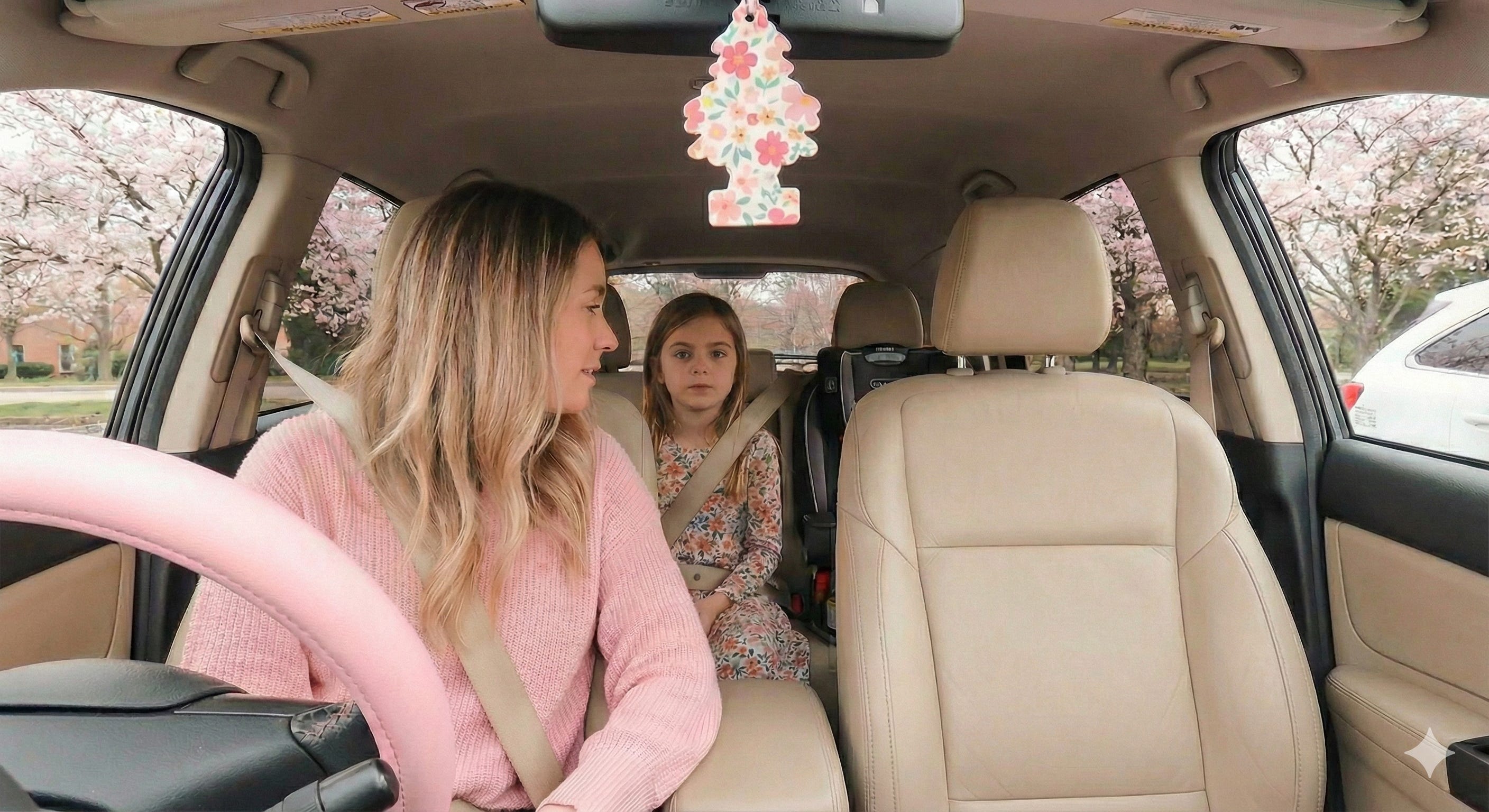
(I wish my steering wheel were that cute!)
I was halfway to my friend Sarah’s new apartment when it hit me.
My daughters were in the backseat; my eldest was chattering about her day, while my youngest played with a toy. We were going to visit Sarah, who had recently separated from her husband and moved into a small apartment near us. It was meant to be a casual visit, a chance for her to have some company in her new space.
But as I drove, my mind started simulating what would happen when we arrived.
We’d walk in. Sarah would greet us warmly, trying to seem okay. My eldest would look around at the unfamiliar apartment, smaller than Sarah’s old house, boxes still unpacked, some furniture still unassembled. And then, inevitably, within five minutes:
“Where’s Uncle Mike?”
I could see it so clearly. My daughter’s innocent, curious voice. The confusion on her face as she tried to make sense of why Sarah was living somewhere new, somewhere without Mike.
The question would land like a stone. Sarah would have to answer, either deflect unconvincingly or try to explain her separation to a seven-year-old while standing in her half-unpacked apartment, holding herself together in front of company.
I pulled into a parking lot.
“Hey sweetie,” I said, turning to face my eldest. “Before we go to Sarah’s, I need to tell you something. She’s living somewhere new right now, and we’re not going to ask questions about it, okay? We’re not going to mention Uncle Mike or ask why she moved.”
My daughter looked at me, processing. “Why not?”
“Because sometimes grown-ups go through hard things, and it’s not easy to talk about. We’re going to visit and have a nice time, but we’re going to let her bring those things up if she wants to, okay?”
“Okay.”
What Just Happened?
That moment in the car, when I pulled over to prepare my daughter, was understanding in action. But to get there, I had to build and coordinate multiple internal models simultaneously:
I modeled Sarah’s internal state:
I’ve never been divorced. I’ve never had to pack up a shared life and move into a small apartment alone. But I could generalize from my own experiences of loss and separation. I built a mental simulation: What would I feel if I had just left my partner? What would it be like to be in this new space that doesn’t feel like home yet, trying to appear okay when someone visits?
I could predict that certain topics like her ex-husband, why she left, or where he is now would surface emotions she may not be ready to navigate, especially not while hosting guests, especially not while answering a child’s questions.
I modeled my daughter:
My daughter is seven. She’s observant and curious. She asks questions to make sense of changes in her environment, and she doesn’t yet have the social awareness to recognize when questions might cause pain.
Without preparation, I knew exactly what would happen: confusion about the new apartment, natural curiosity about Mike’s absence, direct questions asked with complete innocence but devastating impact.
I modeled the interaction between them:
What would happen when that innocent question hit? Sarah would answer kindly, she always does, but I could see the effort it would take. The composure she’d have to maintain. The awkward explanation to a child who couldn’t fully grasp adult relationship complexity. The heaviness that would settle over the visit, making everyone uncomfortable.
I acted on these models:
So I pulled over. I gave my daughter just enough information to navigate the situation without causing unintentional harm. I adapted my approach based on mental simulations of people and scenarios I had never directly experienced.
This is what understanding looks like:
Generalization from indirect experience: I’ve never been divorced, but I could model what that might feel like
Multi-agent simulation: I simultaneously modeled Sarah’s emotional state, my daughter’s likely behavior, and how they would interact
Prediction: I anticipated what would happen without intervention
Meaningful action: I changed course based on those predictions
There was no rulebook for this. No equation I could apply. I had to construct internal models of multiple minds, predict their interaction, and adapt my behavior to prevent harm.
I never directly experienced this scenario, yet I could respond meaningfully because understanding allows you to generalize beyond direct experience.
When Threats Lose Meaning: An Absence of Understanding

Now consider a very different scenario.
Imagine you walk up to an anthill and see a trail of ants marching steadily toward a path near your house. You crouch down and announce clearly to the ants: “If you don’t change course in the next hour, I will destroy your anthill.”
What do you suppose the ants will do?
Experience and common sense tell us: nothing. They will continue marching along their pheromone trail, completely unaffected by your warning.
Not because they don’t take the threat seriously. Not because they wouldn’t care about defending their territory (ants absolutely defend their colonies, often fighting to the death. They have complex behaviors around threat response and colony protection).
But because they cannot draw meaning from your words.
You spoke. Your voice created sound waves that physically reached them. The information was transmitted. The acoustic signal arrived at their location. But no understanding occurred. The ants couldn’t extract significance from those sound waves because they lack the internal models necessary to map your language onto concepts like “threat,” “time,” “consequence,” or “destroy.”
This is the crucial difference:
When I prepared my daughter before visiting Sarah, I was building internal models and making predictions about mental states, social dynamics, and emotional responses. I was extracting meaning from patterns I’d observed and generalizing to new situations.
The ants, faced with a direct warning about their survival, cannot do this. They cannot:
Model what “destruction” means
Represent future time (”in the next hour”)
Map sound waves to concepts
Predict consequences
Adapt behavior based on linguistic input
The information reached them. But understanding did not occur.
This is what absence of understanding looks like: information without the capacity to extract meaning, to build models, to predict, to adapt.
Understanding isn’t just about receiving signals. It’s about having an internal architecture sophisticated enough to transform those signals into meaningful representations that can guide behavior across novel situations.
Another Example: Lost in Translation

Here’s a scenario you’ve probably experienced: You’re out with a new friend and their long-term partner. Everyone’s speaking the same language. You know all the words being used. But as the night goes on, you find yourself increasingly lost.
They’re laughing. Having a great time. Referencing things that seem to delight them both. You try to follow along:
“Should we do the thing?”
“Oh god, not the thing.” laughter
“Remember what happened last time?”
“That was YOUR fault!”
You understand every individual word. You know what “thing” means, what “last time” means, what “fault” means. But you have no idea what they’re actually talking about. Every time you think you’ve figured out the context they pivot and you realize you were completely wrong.
This isn’t a language barrier. You’re fluent in English. You can parse the grammar, define the vocabulary, follow the sentence structure.
But understanding didn’t occur because what a word means and what it signifies aren’t always the same thing.
“The thing” doesn’t mean “a thing.” It signifies something specific in their shared history, maybe an inside joke, a ritual, a particular restaurant, a disastrous camping trip. The meaning of “the thing” exists in the relational space between them, built from experiences you weren’t part of.
You’re receiving all the information. The sound waves are reaching you. You’re processing the language successfully. But you cannot extract the significance because you lack the shared context, the internal model of their relationship, their history, their private language, that would allow you to map their words onto actual meaning.
This is what it looks like when understanding is absent despite linguistic competence.
The ants couldn’t understand because they lack the architecture to map sound to meaning at all. You can’t understand your friends’ conversation because you lack the specific relational context that gives their words significance.
Both demonstrate the same principle: Understanding requires internal models that can extract meaning from signals, not just process the signals themselves.
Putting It All Together: Prediction and Coherent Action
Notice the fundamental difference between these scenarios.
When understanding was present (preparing my daughter before visiting Sarah), I was able to:
Build accurate internal models of multiple people’s mental states
Predict what would happen without intervention
Act coherently on those predictions to prevent harm
The outcome validated my understanding: the visit went smoothly, no painful questions were asked, and my friend was able to enjoy company without navigating emotional landmines.
When understanding was absent (the ants, the couple’s inside jokes), the result was:
No meaningful prediction possible
No coherent action taken based on the communication
Inability to respond appropriately or connect meaningfully
The ants continued marching despite a direct threat to their survival because they couldn’t extract meaning from the warning. You sat bewildered at dinner, unable to participate in the conversation, because you couldn’t map their words onto actual significance.
This is how you identify whether understanding is present or absent: Can the system make accurate predictions and act coherently based on those predictions?
Understanding isn’t a mysterious inner quality we can never observe. It manifests in behavior: in the ability to generalize from past experience, build models of novel situations, predict outcomes, and adapt actions meaningfully.
When understanding exists, you see coherent responses to context, appropriate adaptation to new situations, and accurate predictions about how things will unfold. When understanding is absent, you see inability to respond meaningfully despite receiving information, failure to adapt to context, and incoherent or inappropriate actions.
This is true whether we’re evaluating humans, animals, or artificial intelligence systems.
Thank you.
It is a beautiful narrative of human processes based on layers of contextual, historical, emotional, or implicit interpretation. These layers arise from embodied subjectivity, which is constructed through empiricism.
But how is it relevant to apply this framework as is to a non-human process, in a shift that nothing here explains?
I have read nothing more here than yet another anthropomorphic projection. It is appealing, but it overlooks the legitimacy of such a direct transfer.
Anyway, if AI regularly hallucinates, allowing oneself to be seduced by an illusion is very human.